Sea Freight to Africa in 2026: FCL or LCL for Africa
For an importing SME, the right trade-off is not just about the freight rate. Here is a simple method to choose between FCL, LCL and multi-supplier consolidation based on landed cost, useful lead time and real risk.
Rédaction Shipsen Market
8 min read
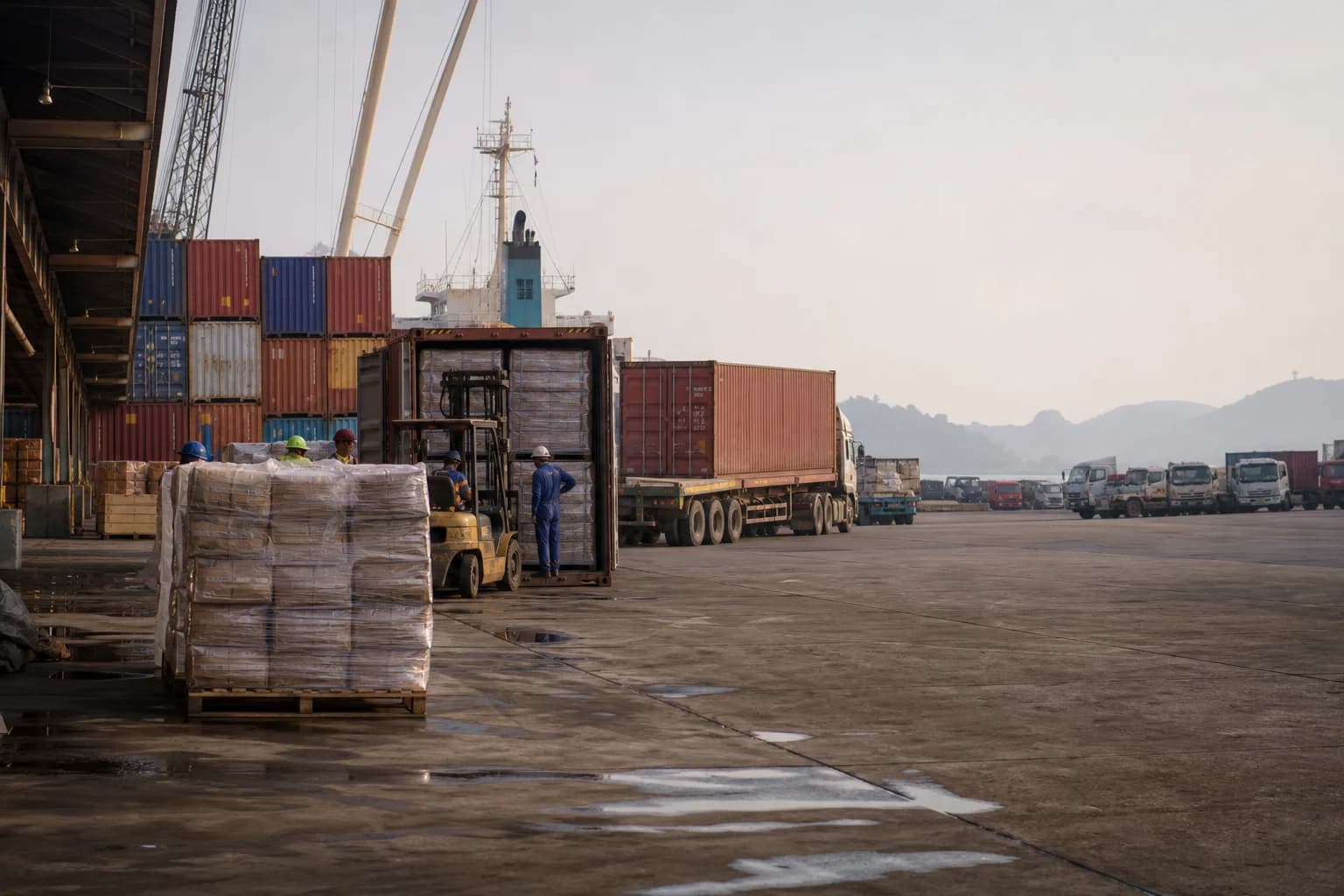
In 2026, the real issue is no longer just negotiating a better rate, but knowing how to decide quickly between FCL or LCL Africa based on landed cost, useful lead time and actual risk. For many importing SMEs, margin is lost in invisible costs: handling, waiting at the port, damage, incomplete documents or fragmented delivery. The right decision is to compare the total cost per delivered cubic meter, not the “sea freight” line item in isolation.
What FCL, LCL and buyer-side consolidation really mean
FCL means Full Container Load: you book a full container, even if it is not 100% filled. In practice, the value of FCL is not only capacity; it is also a simpler chain, with fewer breaks in handling and fewer intermediate touchpoints.
LCL means Less than Container Load: your goods share a container with cargo from other shippers. You usually pay by cubic meter, sometimes with a minimum billable basis, plus several fixed consolidation charges at both ends.
Buyer-side consolidation, or multi-supplier consolidation, is a specific form of LCL or FCL. Several orders from different factories are grouped into one shipment, often in a consolidation warehouse before loading. This option can reduce purchasing and transport costs, but it adds a layer of documentation and operations.
- FCL: easier to control, better for bulky, fragile or moisture-sensitive products.
- LCL: useful for small volumes, market testing, cautious replenishment.
- Multi-supplier consolidation: relevant when the buyer wants to combine several small orders to avoid scattered shipments.
The point that is often overlooked: two shipments with the same freight cost can have very different landed costs depending on the Incoterm, port charges, the nature of the goods and the number of parties involved. If your teams want to clarify how risks and costs are allocated, also read this article on Incoterms.
The calculation that matters: landed cost per cubic meter and cost per day saved
To make the right decision, start from a common unit: landed cost per cubic meter or, if it is more relevant for your business, landed cost per ton or per saleable unit.
The basic calculation looks like this:
- Ex-works purchase price
- Local pre-carriage
- Consolidation or container loading charges
- Main sea freight
- Insurance
- Charges at the arrival port
- Customs clearance and any inspections
- On-carriage to your warehouse
- The financial cost of lead time: cash tied up, stockout avoided or not
Then add a second indicator: cost per day saved. If switching from LCL to FCL costs a little more but saves you several useful days, the extra cost may pay off if:
- you avoid a stockout at a distributor;
- you reduce safety stock;
- you secure a seasonal sales campaign;
- you limit the risk of demurrage or port storage.
For an SME, this calculation is often worth more than a market forecast on freight rates. The goal is not to guess the “best month,” but to buy the right logistics solution for the right order mix.
| Criterion | FCL | LCL | Multi-supplier consolidation |
|---|---|---|---|
| Pricing model | Per container | Often per m³ + fixed charges | Depends on warehouse, volume and number of suppliers |
| Handling steps | Fewer | More | Many before loading |
| Risk of damage | Generally lower | Higher if packaging is average | Depends on control at the consolidation warehouse |
| Flexibility for small volumes | Low | High | High |
| Documentation complexity | Medium | Medium | High |
FCL or LCL Africa: when LCL becomes more expensive than FCL
The tipping point does not happen at a universal threshold, because everything depends on the route, the port, the type of cargo and local charges. But in practice, LCL often loses its advantage well before a container is completely full.
Why? Because LCL usually combines:
- receiving charges at the consolidation warehouse;
- additional documentation charges;
- deconsolidation charges at destination;
- extra lead time linked to consolidation and handover of the lots;
- a higher risk of disputes over billable volume or the condition of packages.
As a rule of thumb, many importers start seriously comparing FCL as soon as they reach a meaningful average volume on the same destination, or when they ship goods with low unit value but high volume. Conversely, for a product launch, an urgent replenishment of a few pallets or a very wide range of SKUs in small quantities, LCL often remains the rational option.
Watch these signals closely:
- Volume is rising but remains fragmented: you think you are saving with LCL, but the fixed charges keep repeating.
- The arrival port is congested: each extra day increases the real cost.
- The cargo is fragile: the more handling there is, the more the “cheaper” option becomes costly.
- You have several suppliers in the same period: a consolidated FCL can become cleaner than stacking multiple LCL shipments.
In other words, the right threshold is not only about volume; it is also documentary, commercial and operational.
Multi-supplier consolidation: advantages, limits and documentation traps
Multi-supplier consolidation can be very effective for an SME buying from several factories in Asia, the Middle East, Europe or North Africa. It allows dispersed orders to be combined, space to be used better and, in some cases, a shift from repeated LCL shipments to a consolidated FCL.
The advantages
- Better loading density and therefore a clearer unit cost.
- One single arrival to manage instead of several staggered flows.
- Fewer stockouts if purchases are planned around a shipping window.
- Possible quality and quantity control before loading.
The limits
- Departure can be delayed by the last supplier who is not ready.
- A documentation error on a single lot can block the whole shipment.
- Incompatible goods should not be grouped without precautions.
- Tracking becomes more demanding for the purchasing and forwarding team.
The traps to anticipate
From the outset, ask who issues what: commercial invoice, packing list, certificates, package marking, lot references, validated weights and volumes. If you import products subject to standards, licenses, sanitary control or inspection, check that consolidation does not make acceptance at destination more difficult.
A good habit is to create a pre-consolidation checklist for each supplier:
- confirmed cargo ready date;
- verified dimensions and weights;
- export packaging suitable for consolidated shipping;
- documents sent before pickup;
- photos of packages and consistent labeling;
- pallet, fumigation or marking rules respected.
Simple automation tools can help control this data upstream; on that point, using AI on the import side can save time on document discrepancies and supplier follow-up.
Ports, demurrage, cargo damage, inspections: the hidden risks to budget for
The wrong choice between FCL and LCL does not only cost you in freight. It often costs you in friction costs.
Among the cost items to budget for systematically:
- Demurrage and detention: in FCL, late pickup of the container or late return of the equipment can become expensive quickly.
- Port storage: in LCL, delayed deconsolidation or late cargo release increases the bill.
- Damage: crushed corners, moisture, rehandled pallets, lost labels.
- Inspections and controls: some goods are subject to checks that immobilize the cargo.
- Volume or weight discrepancies: common in consolidation if measurements are not locked in before shipment.
In several African ports, the real cost is not the ocean leg but the port-customs-final delivery interface. A solution that is theoretically cheaper at origin can become the most expensive at destination if it multiplies operations. That is why the most disciplined SMEs compare their past shipments by final landed cost, file by file, not quote by quote.
A simple decision framework for importing SMEs
Here is a practical method for deciding.
- Measure your shipment: volume, weight, value, fragility, product compatibility.
- Calculate the full landed cost for three scenarios: LCL, FCL, multi-supplier consolidation.
- Assign a value to lead time: how much does a day lost or gained cost your sales?
- Assess documentation risk: how many suppliers, how many SKUs, what regulatory requirements?
- Choose the most robust mode, not just the cheapest on the initial quote.
In practice, what should you do right now?
- Ask your freight forwarder for three comparable quotes, with all origin and destination charges visible.
- Require an estimated landed cost per m³ and a realistic door-to-door schedule.
- Set an internal threshold: beyond a certain volume or number of suppliers, the file must automatically compare FCL and consolidation.
- For fragile or high-value products, prioritize the solution with the fewest handling steps.
- After each import, record the real final cost, days lost and incidents; this is the database that will improve your next decisions.
So the best choice is not “always FCL” or “always LCL.” For an importing SME, the right trade-off is the one that protects net margin, secures delivery and reduces documentary surprises. In 2026, this is a logistics procurement discipline in its own right.
Frequently asked questions
At what volume should you seriously compare FCL with LCL?
As soon as your volume becomes meaningful on the same route, or when fixed LCL charges keep repeating across several lots. There is no universal threshold: always compare the full landed cost, not freight alone.
Does multi-supplier consolidation always reduce costs?
No. It can reduce unit cost if departures are well synchronized, but it can also create delays, documentation errors and extra origin charges. It should be managed with a strict checklist.
Which mode is safer for fragile products?
In general, FCL is more protective because it limits intermediate handling. In LCL or consolidated shipping, export packaging, bracing and labeling become even more critical.
Why does a cheap LCL offer sometimes become more expensive on arrival?
Because freight charges are often only part of the picture. Receiving, deconsolidation, documentation, storage, delays and sometimes more damage can all be added. The initial quote does not always reflect the total landed cost.
- #fret maritime
- #import Afrique
- #FCL
- #LCL
- #groupage
- #logistique internationale
Shipsen Insights content is provided for information. Shipsen Market is a platform that connects buyers and suppliers: always check terms, prices and regulations with your partners and the authorities before any commitment.