Importing flexible packaging into Africa: secure your purchases in 2026
Demand for pouches, films and printed rolls is rising in Africa, but specification mistakes are costly. Here is how to compare finished imports, local conversion and printed rolls with a safer sourcing method in 2026.
Rédaction Shipsen Market
8 min read
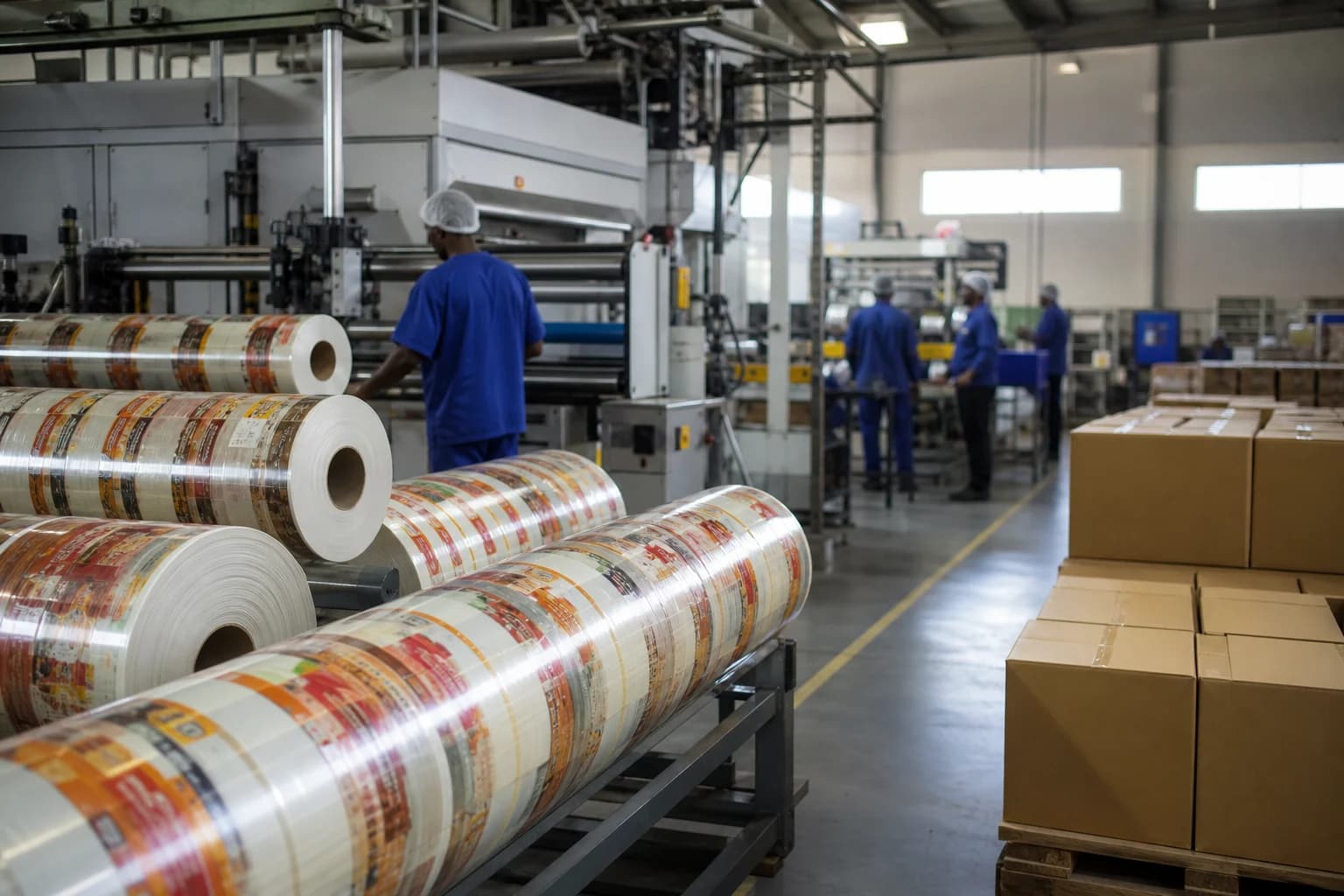
Importing flexible packaging is becoming more strategic for African manufacturers and distributors. With rising requirements for print quality, barrier properties, compliance and recyclability, a small difference in microns, structure or sealing can significantly change the final cost and scrap rate. In 2026, buying well is no longer just about negotiating a price per kilo: you need to compare the industrial model, the pack’s real performance and the delivered-to-warehouse cost.
Where demand is heading in Africa
Demand is growing first in food processing: flours, spices, biscuits, repacked rice, sugar, snacks, powdered dairy products, sauces and beverages in sachets. The same trend is visible in detergents and household care, where refills and small pack sizes remain important to keep retail prices affordable.
Packaged water, some hygiene products and several fast-moving consumer goods are also driving the market. In many countries, modern retail is gaining ground, but traditional trade still carries significant weight. As a result, buyers must serve both high-turnover retail formats and better-presented references for supermarkets, pharmacies or cash & carry.
This shift is changing packaging expectations:
- better print quality to stand out on shelves;
- more stable barrier properties to protect against moisture, grease, oxygen or odours;
- higher machine speeds at packing plants;
- regulatory pressure on certain plastics, minimum thickness, labelling and sometimes recycled content;
- the search for unit cost savings despite logistics costs that remain volatile.
For importers, this makes trade-offs between Asian, Turkish and regional suppliers more sensitive. The right choice depends less on the country of origin than on the fit between the film structure, the packaged product, the packing machine and the actual volume.
The 8 specifications that really change the price
In flexible packaging, price is not only linked to total weight. Eight variables have a major impact on both cost and performance.
- Thickness in microns. A few extra microns across large volumes quickly raise material cost. Going too low, however, increases the risk of punctures, leaks or poor pack strength.
- Film structure. Mono-material PE or PP, duplex, triplex, with or without metallization, paper/plastic, PET/PE, BOPP/CPP, and so on. The structure determines stiffness, gloss, barrier performance and sealability.
- Width and print repeat. These affect production yield and material consumption.
- Number of colours and print quality. Spot colours, four-colour process, opaque white, varnish, tight registration: each technical requirement can add cost.
- Type of sealing. Heat sealing, sealing window, seal strength, performance on vertical or horizontal machines.
- Barrier properties. Against moisture, oxygen, light, aromas or grease. This is critical for sensitive food products.
- Finishing and conversion. Finished pouch, printed rollstock, pre-cutting, zip, handle, notch, gusset, perforation, valve.
- Compliance and tolerances. Acceptable variation in basis weight, colour, dimensions, slip, ink adhesion, migration for food contact.
The most common point of dispute remains simple: the buyer describes a commercial use, the supplier responds with an “equivalent” structure, but nobody locks in measurable performance. The need therefore has to be translated from a marketing brief into a technical specification sheet.
Practical example
A pouch for powder detergent must withstand filling, handling and sometimes ambient humidity, without necessarily needing the same barrier as a fatty snack or an aromatic spice. On the other hand, biscuit packaging may look “good” on delivery but fail after a few weeks if the barrier or sealing is insufficient.
Importing flexible packaging: finished pouches or printed rolls?
The right model mainly depends on three factors: your volume, your local conversion capacity and the cost of poor quality.
| Option | When it makes sense | Advantages | Points to watch |
|---|---|---|---|
| Imported finished pouches | Modest volumes, no conversion workshop, urgent need | Fewer local operations, more standardized quality | Bulky freight, less flexibility, sometimes high MOQs per design |
| Imported printed rolls + local conversion | Regular volumes, machine available, several formats to produce | Less transport volume, flexibility in cutting/pouch making, local adaptation | Machine settings, start-up waste, shared responsibility if defects occur |
| Full local conversion | Reliable industrial ecosystem, short lead times, varied small runs | Responsiveness, rapid testing, lighter inventories | Print quality or structure not always equivalent, variable material cost |
Importing finished pouches often suits brands that are starting out, distributors that do not want to invest in conversion, or medium-turnover SKUs. Printed rolls become attractive when volumes increase and the local setup has strong control over sealing and cutting.
Many buyers underestimate local industrial losses: set-up scrap, tension errors, wrong sealing temperature, friction variation, print registration defects. A cheaper roll on the invoice can end up costing more if the line loses too much time or material.
For importers working across several countries or several plants, it can be useful to standardize the format of the specification sheet and automate part of the supplier comparisons; the article AI for African importers: 7 uses that reduce costs, delays and errors offers practical ideas on this point.
How to qualify a supplier without getting it wrong
A good flexible packaging supplier is not just a good printer. They must understand the final application, accept clear tolerances and document their controls.
Sample tests to request
- Artwork proof or printing cylinder approval to validate colours, text, codes and registration.
- Machine samples tested on your line or on a comparable line.
- Sealing trials at different temperatures and speeds.
- Drop, compression or handling tests if the product is heavy or abrasive.
- Odour and migration checks for food contact where needed.
- Short ageing test to check for delamination, ink transfer or loss of performance.
Recurring defects to monitor
- colour variation between batches;
- poor print registration;
- lamination defects or bubbles;
- leaking seals;
- uneven thickness;
- badly wound rolls or telescoped edges;
- slip properties unsuited to the machine;
- residual ink or solvent odour.
Always ask for a technical data sheet, a batch inspection report, the structure description, dimensional tolerances and, for food packaging, the relevant compliance documents for your market. If Turkey, Asia or regional sourcing options are competing, compare them on identical specifications, not just an identical photo.
The choice of Incoterms and responsibility for transport damage should also be clear; for a useful refresher, see Exporting from Morocco to West Africa: Incoterms explained.
Total landed cost to warehouse: the point that really decides
The right comparison is not the ex-works price, but the total landed cost to warehouse and ready for use. You need to include:
- material and printing price;
- cylinder or plate charges;
- minimum order quantities by structure and by design;
- sea or road freight, insurance, port handling, customs clearance;
- duties and taxes according to local classification;
- start-up losses and internal scrap;
- inventory carrying cost linked to lead time;
- the cost of delays if your plant stops or your promotional campaign slips.
With finished pouches, transport volume can weigh heavily on the economics. With rolls, transport is often more efficient, but you must add local conversion, maintenance and operator skills. MOQs are decisive: a low unit price does not help if you tie up too much stock in a slow-moving design.
In 2026, the other key variable remains regulation. Some markets are imposing stricter rules on non-recyclable packaging, overly thin bags or certain single-use applications. Before ordering, check local requirements on thickness, marking, composition and, where relevant, extended producer responsibility. A film that is technically sound but weak from a regulatory standpoint becomes a commercial risk.
Procurement checklist and what to do now
To avoid disputes over colour, weight and performance, formalize your purchase in six steps.
- Define the exact use. Product, net weight, desired shelf life, sales channel, storage conditions, machine type.
- Write the specification sheet. Structure, microns, dimensions, winding direction, core, print repeat, number of colours, seal type, tolerances.
- Validate real samples. Not just a photo or an empty sample: test under actual filling conditions.
- Compare three quotations on the same basis. Include tooling, MOQ, lead time, Incoterm, quality documents and claim conditions.
- Calculate the landed warehouse cost. Add freight, taxes, scrap, safety stock and local machine cost.
- Contract the quality acceptance rules. Define what is a blocker and what falls within agreed tolerances.
What should you do this week? Split your SKUs into three groups: products sensitive to barrier performance, products mainly sensitive to price, and products where print appearance is decisive. For each group, test a different industrial model: imported finished pouch, printed roll with local conversion, or regional sourcing. This approach reduces costly mistakes and helps you negotiate with solid specifications rather than vague promises.
If you already buy through a B2B marketplace like Shipsen Market, apply the same documentation discipline: sourcing speed helps, but it is the precision of the specification sheet that truly secures the purchase.
Frequently asked questions
Should you import finished pouches or printed rolls?
Finished pouches often suit modest volumes and companies without local conversion capacity. Printed rolls become more competitive when volumes are regular and your conversion line has good control over sealing, registration and start-up waste.
Which specifications cause the most disputes?
Disputes usually focus on actual thickness, film structure, colour, print registration, seal strength and dimensions. These points should be written into the specification sheet with quantified tolerances and batch acceptance conditions.
How should you compare offers from Asia, Turkey and regional suppliers?
Compare only on equivalent structure and performance. Include ex-works price, tooling, MOQs, freight, taxes, lead times, internal losses and local regulatory risk. The lowest quotation is not always the lowest total cost.
What sample tests should you request before ordering?
Ask for trials on your machine or a comparable one, sealing tests at several temperatures, colour checks, dimension and thickness verification, and, for food packaging, compliance documents suited to your market.
- #emballage
- #importation Afrique
- #emballages souples
- #sourcing fournisseurs
- #agroalimentaire
- #logistique
- #contrôle qualité
Shipsen Insights content is provided for information. Shipsen Market is a platform that connects buyers and suppliers: always check terms, prices and regulations with your partners and the authorities before any commitment.